The Through-Line MethodSM
Most organizations have communication plans. Few have a coherent through-line — a spine of meaning that holds the story together across messages, audiences, and time. When (for example) a restructuring is announced, a leader transitions, or a change asks employees to do something different, the quality of communication in that window either protects credibility or erodes it.
The Through-Line Method is how I help leaders, teams, HR partners, and executives find that “story spine” and hold it. The work moves through four stages, with a deliberate front door, called The Opening Brief.
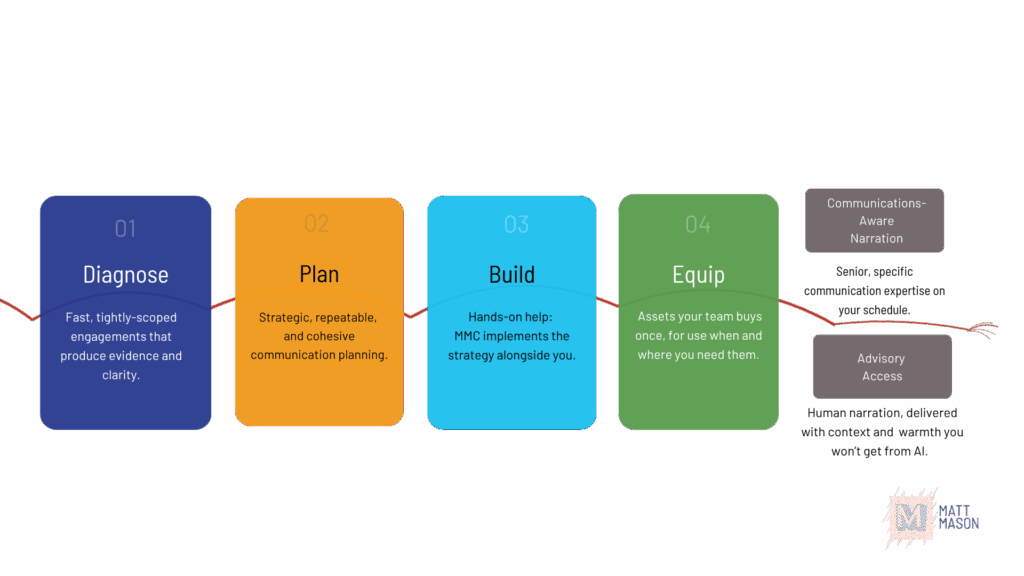
How the Work Moves
With or without the Opening Brief, work typically moves through these stages – led and informed by discovery and our work together.
Diagnose
Fast, tightly-scoped engagements that produce evidence and clarity.
When you need an outside read — on the function, on a single initiative that simply must succeed, or on what employees think — Diagnose engagements produce the answer in weeks, not quarters. Each engagement leaves you with documented findings and clear next moves, not just a transcript and a deck. “Diagnose” activities commonly include at least one of these:
- Internal Communications Diagnostic – Quick Assessment
- Internal Communications Diagnostic – Comprehensive Audit
- Focus Group Design, Facilitation & Analysis
Plan
Strategic, repeatable, and cohesive communication planning.
The plans most communications teams want to build but rarely have the time, structure, or air-cover to produce. Each Plan engagement leaves your team with a documented artifact built for the test that comes later — a strategy or playbook the function works from for the year, not a deliverable that sits on a shelf. “Plan” activities commonly include at least one of these:
- Annual Communication Strategy Development
- Editorial & Content Strategy Consulting
Build
Hands-on engagements, where MMC implements the strategy alongside you.
Examples: executive partnership, coaching, copywriting and copyediting, focus group facilitation and analysis, change communication support, and coordinated campaigns. The work is delivered through the engagement; afterward, your team owns the artifacts. “Build” activities commonly include at least one of these:
- Executive Communications Partnership
- Writing & Communication Coaching (for leaders and managers; individual or small group)
- Copywriting & Copyediting
- Manager Communications Capability Program (in development)
- Change Management Communication Support
- Multichannel Campaign Development
Equip
Customized assets your team buys once, for use when and where you need them.
Designed with the “Pack in, pack out” philosophy in mind, “Equip” engagements build capabilities and assets your team can use to be self-sufficient, strategic, and savvy communicators. They’re the opposite of consulting hit-and-runs, where you feel “decked-and-dashed” after a period of major change. Inclusions are dictated by our work together across the other three stages.
Standalone Offerings
Two offerings sit outside the four stages, because they serve a different purpose and, often, follow a different rhythm:
- Advisory Access: Senior communication expertise on your schedule, centered on a specific need, organized around a simple brief, and delivered asynchronously or live.
- Communications-Aware Narration: Human-delivered narration for your organization’s video or other presentations. Best when your content requires an awareness of your business context, error-free delivery, and warmth you won’t get from AI.
The Opening Brief
The Opening Brief is a purpose-built first engagement for prospects who want to know what it’s like to work with a senior communications partner before committing to a larger engagement.
After we talk, I apply my 20+ years of experience to your situation and offer three to five prioritized observations and recommendations, in writing and in a follow-up conversation.
Investment:
$595
Fixed, and credited in full toward any Diagnose engagement commissioned within 60 days