The Clean Shot
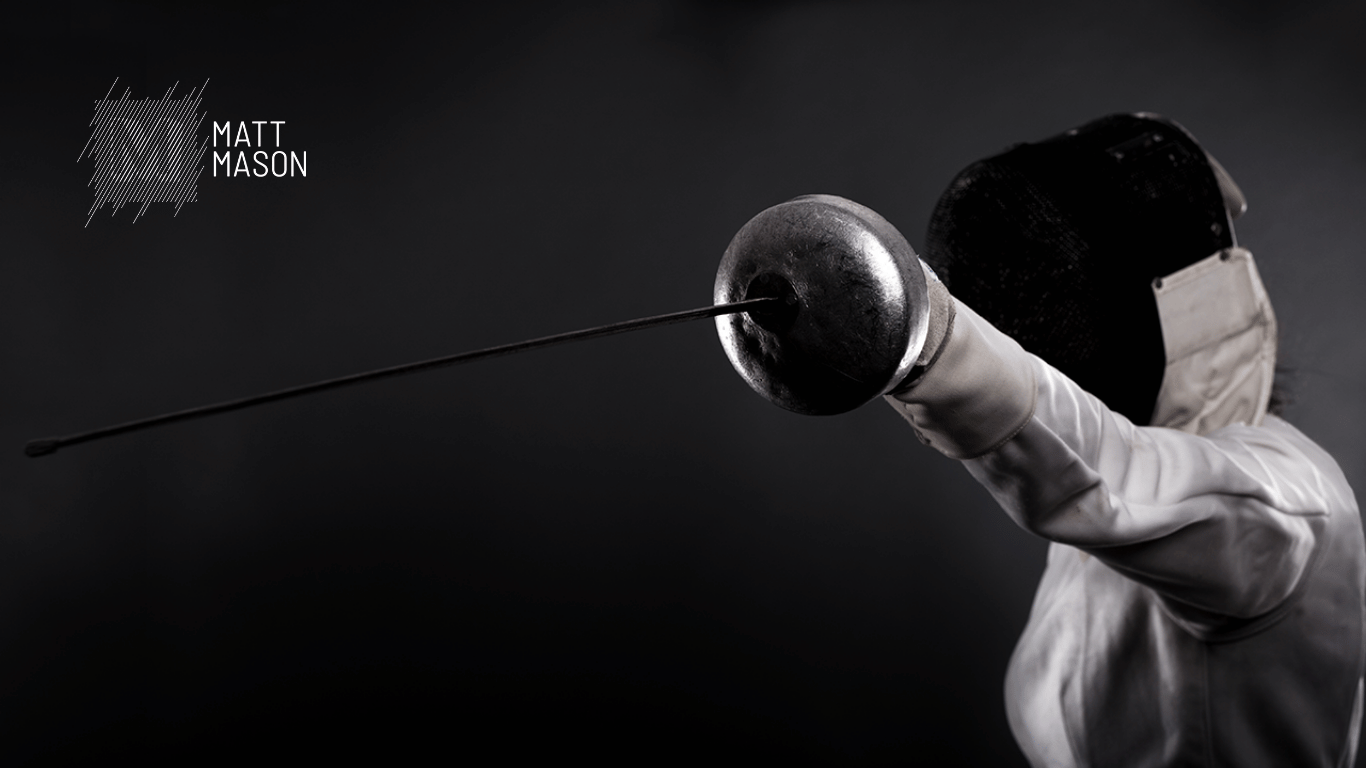
I was at the end of the Post Road gymnasium that always seemed darker than it should have. The ceiling fixtures, caged against errant basketballs, looked like upturned pie plates glowing orange but never quite bright enough to make me feel in control of the space. The dark mesh of the fencing mask made it worse. Depth perception has never been my strength, and now I couldn’t be sure where the tip of my épée hovered in space.
Time slowed. Several times a second I re-grounded myself: feet at a right angle, heels forming the vertex, right hand up behind my mask, left arm out in en garde, the point searching my opponent’s torso, arm, thigh, knee. Foot, even, if I dared. We were well into a five-minute bout, but it felt like an hour. Sound had fallen away, except the occasional buzz of a scoring machine two strips over.
I tapped and stepped, careful not to stand too long. Careful not to hold the centerline, careful not to drift wide and draw a foul. Advance, or advance and lunge? Snap the front foot out and straighten the back leg in one explosive push, aiming high, shoulder or head? A fleche, back foot crossing forward, running at him, the point trading accuracy for speed? Or the rare, infuriating touch to the foot, eye contact held but wrist dropping at the last instant so the blade hung perpendicular and struck laces?
I couldn’t decide. So I bought myself thinking-time. Beat-beat-prise de fer, thrust, take the parry, disengage under it, and step back, ceding the ground rather than pressing my advantage.
It’s 9:15, forty-five minutes past our start time. The account executive is first on the agenda anyway, and he’s running short on client-management platitudes. I don’t yet have the consultant’s sense to know his tap-dancing is running out of taps. No amount of smooth stalling can cover the fact that we’re here to discuss a communications engagement and the communications expert hasn’t shown. No call from the roadside. No warning. She — the rainmaker, the closer, my boss — simply isn’t here.
Stuff can happen to anyone, I tell myself, keeping the shame at bay. I don’t feel like I belong in this room. My suit starts to itch. I’m running hot, listening so hard that my head hurts, hunting for the right thing to say about a point made two seconds ago. Or if not right, just the pithy thing. But I can’t think that fast. By the time I’ve workshopped a line to where I’d be comfortable saying it, the room has moved on.
I’m two months into my first consulting job. I hadn’t been involved enough in building the deck to know how to carry it. When the client manager finally jumps in, a beat or seven later than I’d have liked, he reads my discomfort and pulls from that inch-deep, mile-wide grasp of every practice area’s plan, eyelids flipping like Rolodex cards until they stop on communications, and segues into my boss’s slides. My role shrinks: to clicker, slide-flipper, joke-smiler, serious-point-nodder. It’s 9:18, and my professional future feels entirely up for grabs.
“Yeee—nnnooowww?!”
It barely registers. Only later will I know that was Coach Cal, at the far end of the strip just out of my periphery, telling me not to throw away the only opening I’d get to win this bout. Decisive for our épée squad against Walt Whitman, and the difference in whether I’d letter for a second straight year.
In the moment, I’m still choosing. Arm or shoulder? Head or foot? Lunge or fleche? The toe-touch: worth the risk? I’ve forgotten we’re at la belle,four-four, and that I lost the coin toss for priority at the top of the bout. If it ends as it stands, stationary, silent, I lose everything at stake. All Whitman’s man has to do is stand there. He’s kept his eye focused and his movements efficient, careful, and at least as lucky as mine.
Tick. Tick. Tick.
“Halt. Time has expired. By rule, Red has priority. Bout goes to Red, five-four.”
A cooling rush, blood surging back from whence it had been evicted. The feeling of sweat pouring that isn’t sweat, isn’t external. It’s realization, arriving in the body before the mind.
At the far end, Coach Cal bends at the waist, one hand on his head, clipboard in the other. He isn’t quick to anger, and I don’t think he’s angry now. Just distressed at a lost opportunity. One I lost.
The last chuckles die off. The room turns to me, looking down the boardroom table: and what have you, to entertain the king and his court?
I have it. I can feel the shape of it. Something drawn from what the client said earlier, health-care utilization, the pain point of the year, an easy pivot into the deck. Since you mentioned utilization, we’ve got a few ways to get the ‘right service, right time, right cost’ message in front of employees at the moment they choose where to go for care. Broad enough to open into almost anything in that mystery deck.
It’s the shot. It’s right there.
I take a beat too long. Then another. Long enough that the account executive reads it as blankness and jumps in to save me, makes my exact segue, give or take a word.
And the shot is gone. Nobody calls it. The meeting simply keeps moving.
He carries it from there. Stumbles a little on the communications strategy, and works in a few plugs for other lines of business. Everyone smiles, nods, agrees these are ideas worth pursuing, should thy pricing please the king. The meeting closes smoothly enough.
I’m ashamed. Something in me says I could have done more. Should have said more. And didn’t. On the way out the account executive tries to be encouraging, in that generic Buck up, chum way that’s never worked on me. I tell myself the shot I didn’t take was probably the smart play. It might have missed anyway.
In the office where I write this, I still have the varsity letters, one for every year I fenced. And I know now that almost any attack I mounted in that la belle bout would have beaten standing still. An attack that misses still leaves you on the strip, fencing. An attack never taken hands the bout to the clock.
The rainmaker forced my hand in that meeting, through carelessness, or crisis, or some sink-or-swim test of a green consultant’s nerve. I never learned which. What I learned instead took years: in the quiet after, I’d handed something over. Not to the client, or the room, but to myself. I let the silence stand as a verdict, maybe they’re right, maybe I’m not built for this, and the trajectory at that firm never felt recoverable after.
I shook the other fencer’s hand that day. He asked what year I was in.
“Sophomore,” I said.
“Dude,” he said. “Keep going. You’re going to crush it in a few years. I’m a senior.”
I’d nearly beaten someone two years ahead of me. The only margin against me was ten seconds of stillness.
Today, I don’t wait to open my mouth.